On this page
The header is the first six lines a hiring manager sees on your resume. It sounds simple: name, phone, email, done. But this small block decides whether the recruiter recognizes you as a serious candidate before they even reach your work experience, and a surprising number of resumes lose points right here.
Headers fail in two ways. They include too much (full street address, age, three social links nobody asked for) or they include the wrong thing (a clever title like "Marketing Ninja," a personal email from 2008). Either failure makes the rest of the resume harder to take seriously, even when the experience below is strong.
This guide walks through what belongs in a 2026 resume header, what to leave out, how to format it so it survives an applicant tracking system, and a few examples of what good and bad headers actually look like.
What a Resume Header Is and Why It Matters
The resume header is the block at the top of the page containing your name, target job title, contact info, and a few links a hiring manager might want to follow. It serves three jobs at once.
First, it identifies you. The recruiter needs to know whose resume they are reading without hunting for it.
Second, it tells the recruiter how to reach you. If your phone or email is buried, missing, or wrong, that resume effectively does not exist; nobody will go searching for an alternate way to contact you.
Third, it positions you. The line under your name (your target title) tells the reader, in three to five words, what kind of role you are pitching yourself for. That framing affects how every bullet below is read.
Headers also matter for ATS parsing. Many tracking systems struggle with text in image headers, two-column layouts, or icons replacing labels. A clean header in plain text is the safest format if you want the system to correctly read your name and contact details.
What to Include in Your Resume Header
Six elements, in this order. Anything more is usually noise.
1. Your Full Name
Use the name you want to be called by, in its professional form. "Joshua Hong" not "Josh." "Priya Ramaswamy" not "P. Ramaswamy." If you go by a preferred name that differs from your legal name, list the preferred one ("Sam Chen" instead of "Samantha Chen") so the recruiter knows what to call you.
Format your name larger than the rest of the header (around 16 to 22 points works well) and make it the visually heaviest element. Bold is fine. All caps is fine if it suits the design. Skip cute styling; you want the recruiter to read it cleanly the first time.
2. Target Job Title
The line directly under your name should state the job title you are applying for, not your current title. If you are a marketing coordinator applying for a senior marketing manager role, your header should say "Senior Marketing Manager," not "Marketing Coordinator."
Use the exact wording from the job posting where it is honest. "Software Engineer" beats "Software Wizard." If you are early in your career and have no formal title yet, you can use a degree ("Computer Science Graduate, May 2026") or a clear positioning line ("Aspiring UX Designer with Internship Experience").
3. Phone Number
One number, the one you actually answer. Include the country code if you are applying internationally. Format it the way a recruiter would expect to see it for the country you are applying in.
4. Professional Email Address
Use a version of your name. "[email protected]" or "[email protected]" works. "hongster1995@" or "sk8erboi@" does not, even ironically.
Keep the email address consistent across your resume, LinkedIn, and any portfolio sites. Mismatches make recruiters wonder whether the resume is current.
5. Location
City and state (or city and country, internationally) is enough. You do not need a full street address in 2026; recruiters do not mail offer letters anymore, and including your home address creates a small privacy risk for no benefit.
If you are applying remotely, you can write "Remote (based in Austin, TX)" so the recruiter understands both your time zone and your willingness to work distributed.
6. Relevant Links
One or two, the ones a hiring manager would actually look at. For most candidates that means a LinkedIn URL. For developers, a GitHub. For designers, a portfolio. For writers, a website or Substack.
Skip Twitter, Instagram, and personal Facebook unless they directly relate to the role. Even a great LinkedIn profile is hurt when it sits next to a link to your dormant Pinterest.
What to Leave Out of a Resume Header
Anything in this list either adds zero value or actively works against you.
- Date of birth or age. Not relevant, and in many regions, illegal for the employer to ask about.
- Gender or marital status. Same reason.
- Religious or political affiliations. Off-topic at best, biasing at worst.
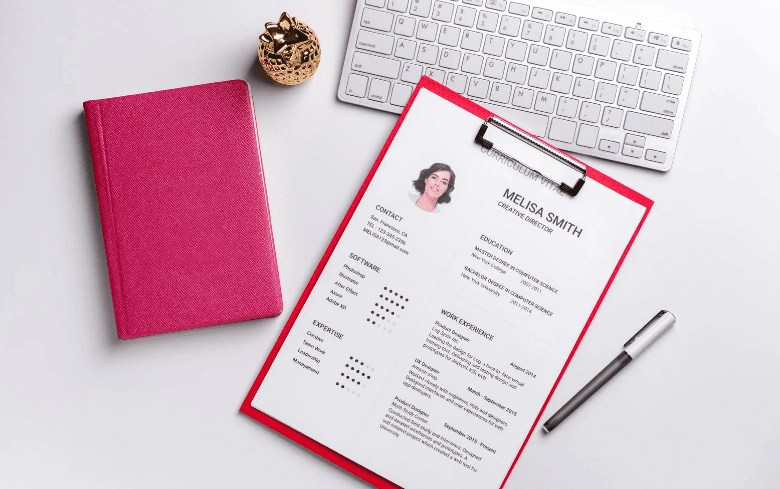
- A photo (in the US, UK, Canada, Australia). Photos invite bias and many ATS systems cannot parse them. Required in some European and Asian markets; check local norms.
- Pronouns (only if you are unsure). Including pronouns is a personal choice and increasingly common; both options are fine. Just be deliberate about it.
- Multiple phone numbers and emails. Pick the one that actually reaches you.
- Unprofessional usernames. If your handle is questionable, do not link to it.
- Long career objectives. The header is not the place. If you want a summary, put it in its own section below.
How to Format Your Resume Header
The visual rules are simple. The goal is fast readability.
- Name large, everything else readable. Name at 16 to 22 points; the target job title at 12 to 14; contact info at 10 to 11.
- Pick a clean sans-serif font. Helvetica, Arial, Calibri, or Inter all work. Match the body of the resume.
- One or two fonts maximum. Mixing three fonts looks chaotic.
- Use color sparingly. A single accent color (deep blue, charcoal, dark green) is fine. Skip neon and bright reds.
- Keep the header on one line or two compact lines. A header that takes a quarter of the page eats the space your work history needs.
- Use plain text, not text-as-image. ATS systems cannot read text inside an image, so a stylish header that lives in a PNG can wipe out your contact info.
- Avoid icons replacing labels. A phone icon next to your number looks fine on screen, but some ATS tools strip the icon and lose the context. Spelling out "Phone:" or just using the number alone is safer.
- Test on mobile. Many recruiters open resumes on their phone first. If your header wraps awkwardly on a small screen, fix it.
Resume Header Examples
A Good Finance Header
Sarah Johnson
Senior Financial Analyst
[email protected] | (212) 555-9182 | New York, NY
linkedin.com/in/sarahjohnson
Why it works: clean, scannable, three-line block. Title states what she is targeting. Location is general. One link, the one a finance recruiter cares about.
A Good Creative Header
Jonathan Lee
Senior Graphic Designer
[email protected] | (323) 555-4017 | Los Angeles, CA
Portfolio: jonathanlee.design | linkedin.com/in/jonathanlee
Why it works: portfolio link is upfront, where a hiring manager for a design role will look first. Email uses the same domain as the portfolio, which signals investment in his personal brand.
A Bad Header
Sammy
SEO Guru and Content Genius
[email protected] | 728-4734-2464 | 1842 Maple Ave, Apt 7B, Dallas, TX 75201
Insta: @sammyspartytime | TikTok: @sammycooks | LinkedIn: linkedin.com/in/sammy-smith-1234
Why it does not work: nickname instead of full name, joke title, casual email, full street address, three irrelevant social links. Each one alone is forgivable; together they sink the resume before the experience section.
The Final Take
The header is the easiest part of a resume to get right. Six elements, in plain text, with your name doing most of the visual work. The hard part is resisting the urge to over-design it or over-share.
Skip the format wrangling and template-shopping. Our AI resume builder handles layout, ATS keywords, and bullet rewrites for you — free to start. Browse resume examples by role to see what good looks like for your target job.
Keep reading
- ATS Resume Guide 2026: How Workday, Greenhouse, and AI Screeners Actually Read You
- CV vs Resume: Key Differences and When to Use Each (2026)
- How Long Should a Resume Be in 2026? Honest Answer
- Resume Headline Examples and How to Write One in 2026
- Resume Summary in 2026: The 4-Line Formula + 16 Examples by Role
- Should You Add a Photo to Your Resume in 2026?