On this page
- Key Takeaways
- What a Cover Letter Actually Is
- The Structure That Works
- Step 1: Research Before You Write
- Step 2: The Opening That Actually Works
- Step 3: The Body, Where You Prove the Fit
- Step 4: The Close
- Step 5: Tailor Every Letter
- Common Cover Letter Mistakes
- Format and Submission Details
- When Not to Send a Cover Letter
- Final Thoughts
- How to Write a Cover Letter FAQ
- Keep reading
The cover letter is the most over-engineered document in the job search. People agonize over it for hours, follow templates that read like circa-2009 form letters, and end up with a page of generic praise that any candidate could have written. Then they wonder why no one calls back.
Here is what actually works in 2026: a short, specific letter that does three things well. It opens with a real hook. It connects two or three of your concrete accomplishments to the job's actual requirements. It closes with a clear, confident next step. That is it. Done well, this takes 45 minutes per application, not three hours, and it materially raises your callback rate.
Key Takeaways
- One page, four paragraphs maximum. Hiring managers will not read more.
- The opening line is the whole game. Skip "I am writing to apply for..." and lead with something specific.
- Tailor every cover letter to the specific role. Generic letters are worse than no letter.
- Show value with concrete results, not adjectives.
- Submit as a PDF named clearly. Small detail, real signal.
What a Cover Letter Actually Is
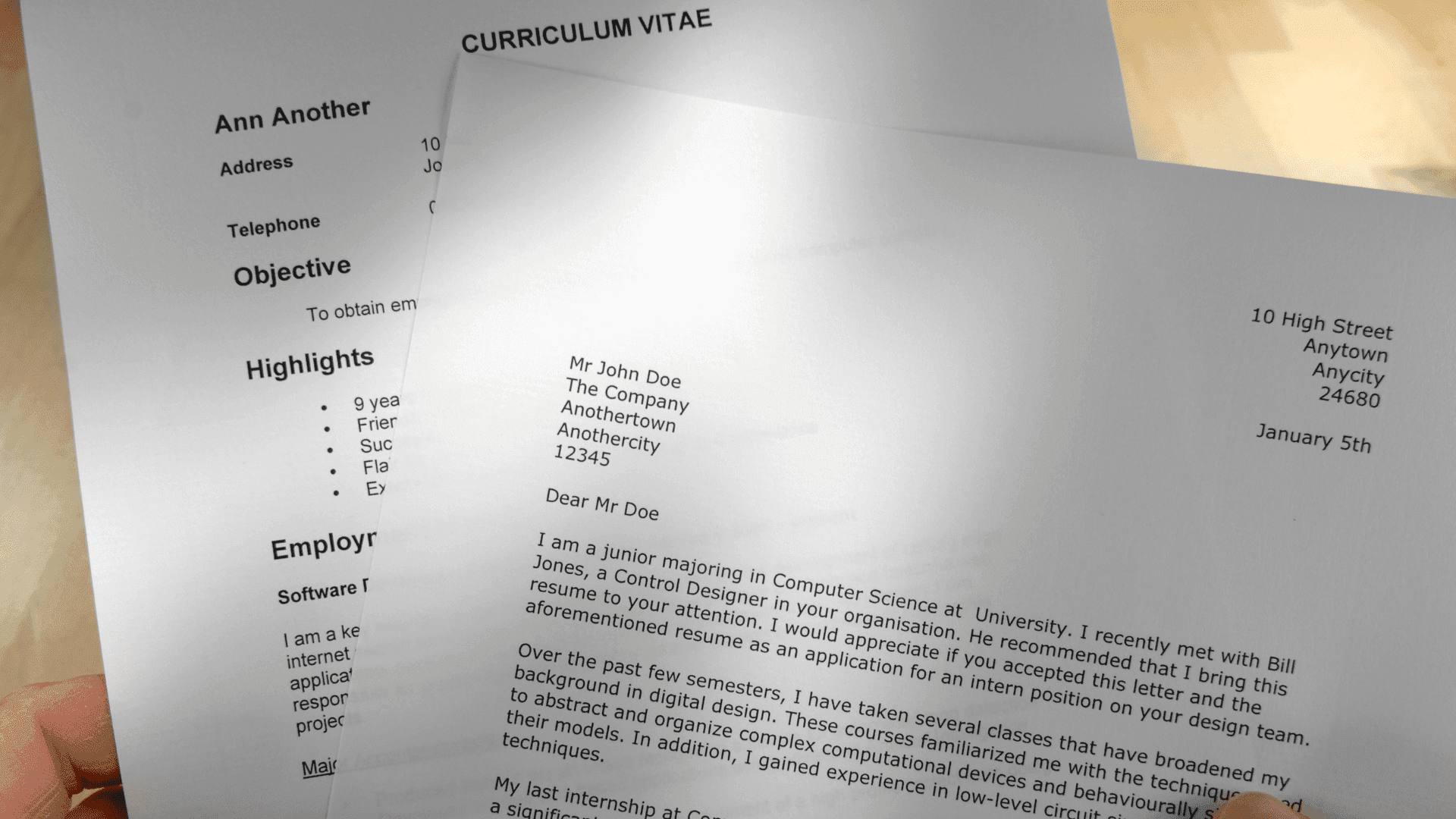
A cover letter is not a longer version of your resume. It is a one-page argument for why you are the right candidate for one specific job. Your resume is the evidence; the cover letter is the case. The two work together, but they have different jobs.
Hiring managers read most cover letters in 30 to 45 seconds. They are scanning for: do you understand what we do, do you have relevant experience, and would you be easy to work with? Three questions, three answers, three to four short paragraphs. Anything else is filler.
The Structure That Works
A modern cover letter has six pieces, in this order:
- Header. Your name, contact info, and the date. Match the formatting to your resume.
- Salutation. The hiring manager's name if you can find it (LinkedIn, the company website, the job listing). "Dear Hiring Manager" if you genuinely cannot.
- Opening paragraph. One or two sentences that hook the reader. State the role, but earn the rest of the read with something specific.
- Body paragraphs (one or two). Two or three concrete accomplishments mapped directly to what the role requires.
- Closing paragraph. Reiterate fit, signal enthusiasm, and propose a clear next step.
- Sign-off. "Sincerely" or "Best regards," then your name.
Total length: 250 to 400 words. If you are over 400, cut.
Step 1: Research Before You Write
The biggest single difference between cover letters that work and ones that do not is research. Spend 30 minutes on the company before you write a single sentence. Understand the product, the recent news, the team you would join, and the specific challenges the role suggests they are trying to solve.
Then read the job description three times. Highlight every required skill and every outcome the role is supposed to achieve. Your cover letter is going to connect your experience to those highlighted items, with specific evidence.
Step 2: The Opening That Actually Works
The opening sentence is where most cover letters die. Avoid:
- "I am writing to apply for the [Role] position." (Tells them nothing.)
- "I am excited to apply..." (Everyone says that.)
- "My name is..." (It is at the top of the page.)
Instead, lead with a hook tied to something specific. A few formats that work:
- Lead with a result. "In the last 18 months I helped a Series B fintech grow paid acquisition by 240% on a flat budget. The Senior Performance Marketing role at [Company] looks like exactly the kind of challenge I would want to tackle next."
- Lead with a connection. "Maya Chen mentioned that the data team at [Company] is rebuilding the analytics stack from scratch. As the engineer who led a similar rebuild at my last company, I would love to put my experience to work for you."
- Lead with a relevant insight. "The shift you announced last month toward usage-based pricing is one of the most interesting pivots I have seen in the SaaS space this year. As someone who spent the last three years building pricing models for a similar move, I had to apply."
The principle: earn the next paragraph by being specific in the first one.
Step 3: The Body, Where You Prove the Fit
The body is one or two short paragraphs (three to five sentences each) that connect your experience to the role's requirements. Use this structure:
- Pick the two or three most important things the role needs.
- For each, give one specific example with a result, ideally quantified.
- Tie it explicitly to what the company is trying to do.
Example body paragraph:
"At [Previous Company], I led the launch of our self-serve product, which generated $2.4M in its first year and now accounts for 28% of new revenue. The job description mentions you are exploring a similar move; I would bring the playbook for what worked, what failed, and what I would do differently the second time."
That paragraph proves: relevant experience, real outcomes, self-awareness, and direct connection to the role. Three paragraphs like that and the hiring manager is already imagining you on the team.
Avoid the temptation to list every job you have ever had. The cover letter is not a chronology; it is an argument.
Step 4: The Close
The closing paragraph reiterates fit briefly, signals genuine enthusiasm, and proposes a clear next step. Two or three sentences:
"I would love the chance to talk through how my work on [specific thing] might map to what your team is building. I am happy to send work samples or walk through any of the projects above. Thank you for considering my application."
Skip the desperate close ("I would do anything for this job") and the over-formal close ("Should you require further information, please do not hesitate to contact me"). Confident, warm, brief.
Step 5: Tailor Every Letter
The single biggest mistake is sending the same cover letter to ten companies. Hiring managers can spot a generic letter in two sentences, and it actively hurts your chances compared to no letter at all.
Tailoring does not mean rewriting from scratch. Build a strong template with placeholders, then for each application:
- Change the company name and role (everywhere).
- Update the opening hook to reference something specific to that company.
- Swap one or two of your accomplishment examples to match the most-emphasized requirements in that job posting.
- Adjust the closing to reference something concrete.
Done well, this takes 20 to 30 minutes per application. The yield on that time is much higher than sending five generic letters in the same window.
Common Cover Letter Mistakes
- Recycling your resume. If your cover letter just lists the same bullets in paragraph form, it adds nothing. The cover letter should add context the resume cannot.
- Using AI without editing. AI-written cover letters in 2026 are easy to spot: they all sound the same. If you start with AI, rewrite at least 70 percent in your own voice.
- Talking only about yourself. Half the letter should be about the company and the role. If you reread your draft and every sentence starts with "I," you are doing it wrong.
- Going over one page. Nobody reads page two. Cut.
- Over-formal language. "Esteemed organization," "the privilege of working alongside," "to whom it may concern." None of this lands.
- Typos. A typo in a 350-word document is a real signal. Read it out loud once, then have one other person check it.
Format and Submission Details
Small details that hiring managers notice:
- Same font and visual style as your resume. The two should look like a set, not two random documents.
- Save as a PDF. Word documents render unpredictably on different machines.
- Name the file clearly. "Firstname-Lastname-Cover-Letter.pdf" is the standard. Avoid "cover-letter-final-v3.pdf."
- Match contact info. Use the same name, email, and phone format that appears on your resume and LinkedIn.
When Not to Send a Cover Letter
Sometimes the application explicitly says no cover letter. Respect that. Submitting one anyway signals you do not read instructions. Some companies have moved to questions in the application form instead, which serve the same purpose. Treat those answers with the same care you would give a cover letter.
For most roles, though, a sharp cover letter is still a real edge. Hiring managers report it is the tiebreaker more often than candidates realize.
Final Thoughts
A great cover letter is short, specific, and tailored. It opens with a hook, proves fit with concrete examples, and closes with a clear next step. It looks effortless because effort went into the parts you cannot see: the research, the targeting, the editing.
Do this for the five or ten roles you actually want and skip it for the rest. Spraying generic cover letters at fifty companies is worse than sending three sharp ones to the right ones.
Pair a strong cover letter with a strong resume. Our free cover letter generator drafts a tailored letter from a job description in under a minute, and our AI resume builder handles the resume side — free to start.
How to Write a Cover Letter FAQ
How long should a cover letter be?
250 to 400 words. One page maximum, ideally less. If you cannot make your case in 350 words, the case probably is not strong enough yet.
How do I address a cover letter without a name?
Try LinkedIn, the company website's team page, or the job listing itself. If you genuinely cannot find a name, "Dear Hiring Manager" is fine. Avoid "To Whom It May Concern," which now reads as dated.
Are cover letters still required in 2026?
Often optional, occasionally required, rarely useless. For competitive roles or companies you really want, a sharp cover letter is still a real differentiator.
Can I use AI to write my cover letter?
You can use it for a first draft, but rewrite extensively in your own voice. AI-generated letters all read the same after a few paragraphs, and hiring managers are getting fast at spotting them.
Keep reading
- How to End a Cover Letter That Actually Lands an Interview
- How to Write a Letter of Interest in 2026 (With Samples)
- Application Letter Guide for 2026: Structure, 5 Samples, and Modern Norms
- Are Cover Letters Necessary in 2026? An Honest Answer
- How to Write a Letter of Resignation (Template + Examples)
- Cover Letter for Internal Position in 2026: Templates, Examples, and the Phrases That Actually Work